The Flow Reversal
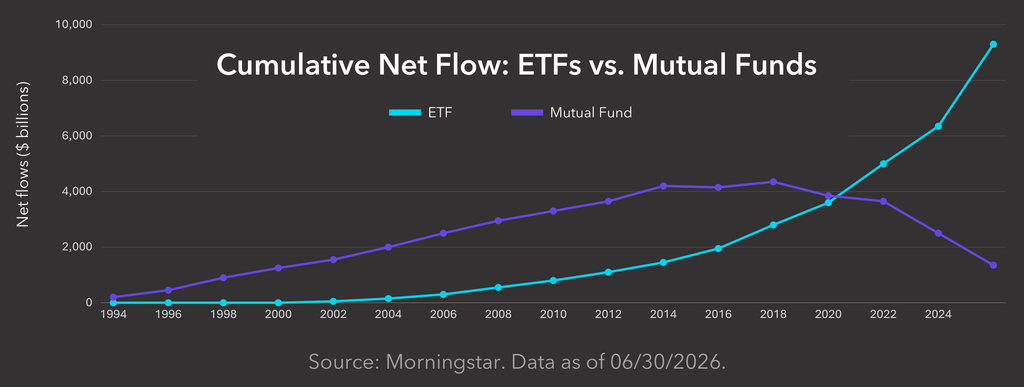
Since 1994, cumulative net flow into mutual funds and ETFs moved in the same direction, until it didn’t. Mutual fund flows peaked around 2016–2018 and have declined since, while ETF flows accelerated past them and are approaching* $10 trillion (Morningstar).
The two lines didn’t just cross. The mutual fund line has been falling for several years running, which is a materially different story than “ETFs are growing faster.” A shrinking cumulative flow line means mutual funds, in aggregate, are now seeing more money leave than arrive.
Where the Money Is Actually Going
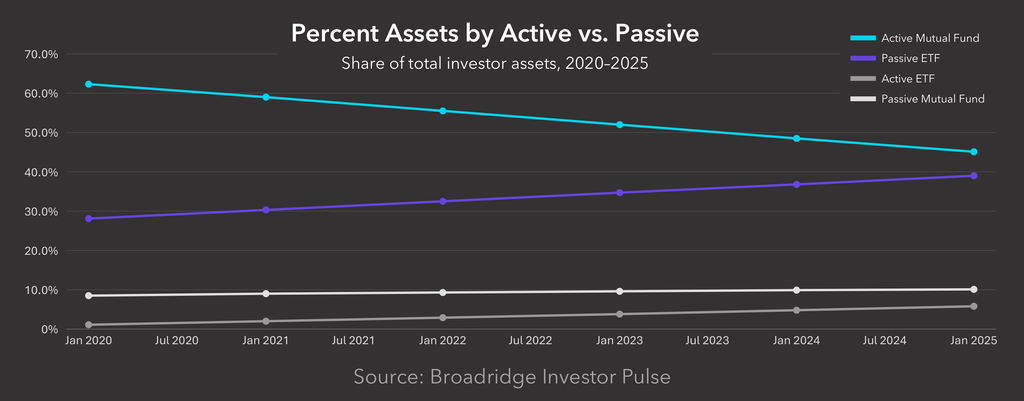
The shift inside the ETF wrapper is just as telling as the shift toward it. Passive ETF share of total investor assets has grown from 28.1% in 2020 to 39.0% today, and active ETF share, still the smallest slice of the pie, has grown nearly six-fold, from 1.1% to 5.8% over the same period. Actively managed mutual funds, by contrast, have fallen from 62.3% of assets to 45.1%** (Broadridge Investor Pulse, data as of December 2025).
Who Is Driving It and Why Advisors Are Following
Broadridge attributes part of the shift to younger investors, a cohort raised on gamified trading apps and a wider menu of asset classes, with more conviction that they can beat a benchmark than prior generations showed. Advisors appear to be adjusting to that appetite rather than resisting it: in a September 2026 survey of 450 advisors across the U.S. and Europe, 87% said they already use active ETFs and 71% expect to increase that use over the next two years*** (MSCI, September 2026). More pointed for existing mutual fund managers, 58% of those advisors said a new active ETF allocation from a manager they already use would most likely displace an existing mutual fund holding rather than sit alongside it.
“What we are seeing is a shift from whether advisers will use active ETFs to where the structure delivers the most value,” said Jana Haines, Global Head of Index at MSCI, in the survey release.
The Honest Caveat
None of this means the ETF wrapper fits every strategy, or that passive investing has lost its footing. Passive vehicles still hold a large portion of assets, and the S&P 500’s recent run is real, not a mirage. The MSCI survey is also a useful check on enthusiasm: only 16% of advisors think private markets belong in an ETF structure at all, and 62% point to a liquidity mismatch between the ETF and its underlying assets as the reason. Not every mutual fund can or should become an ETF; a strategy with illiquid or hard-to-value holdings is a poor conversion candidate regardless of what the flow data shows.
But for a manager running a liquid, exchange-tradable strategy, the flow data and the advisor survey are pointing in the same direction at the same time: existing mutual fund assets are the pool advisors say they’re most likely to move, and advisors increasingly say they would direct that money into an ETF wrapper rather than a competitor’s mutual fund. The managers positioned to capture that potential reallocation, rather than lose it to a peer’s active ETF, are the ones treating conversion readiness, and the trading and operational infrastructure it requires, as a near-term decision rather than a someday one. Conversion does not assure asset retention or new inflows.
Sources
*** MSCI
“Active ETFs Set for Further Growth as Advisers Sharpen Focus on Value and
Fit.” MSCI, 14 Sept. 2026, www.msci.com/discover-msci/media-room/active-etfs-set-for-further-growth-as-advisers-sharpen-focus-on-value-and-fit.
* Morningstar
“The State of US ETFs 2026.” Morningstar, 14 Sept. 2026,www.morningstar.com/business/insights/research/us-etf-market.
** Broadridge Investor Pulse
“Broadridge Investor Pulse.” Broadridge Financial Solutions,
investorpulse.broadridge.com. Accessed 19 Sept. 2026.